Who owns the warning before Kenyans lose their money?
Kenya’s latest investment alert names platforms that had already been flagged by regulators elsewhere, including CBEX in Nigeria and QVSE in Ghana. The problem is no longer access to warnings but what happens after they arrive. Investors need a system that turns cross-border alerts into domestic assessment, assigns responsibility to a named agency and makes the path from first warning to investigation, referral and public protection visible without forcing victims to navigate multiple regulators themselves.

CMA
A Kenyan considering an online investment should not have to search the websites of regulators in Nairobi, Accra and Abuja before deciding whether to send money. Yet those three cities hold different parts of the public warning history of platforms now named by Kenya’s Capital Markets Authority.
In a notice dated 11 September 2026, the CMA identified fifteen entities it accused of soliciting funds unlawfully and fraudulently without the required licences or approvals. They included CBEX, QuantVest Stock Exchange, or QVSE, Global Investment Group and Wealth Sharing Group, also identified as Opticoin. The authority said the entities were under investigation by the Directorate of Criminal Investigations, working with the CMA and other agencies. These are regulatory allegations, not criminal convictions.
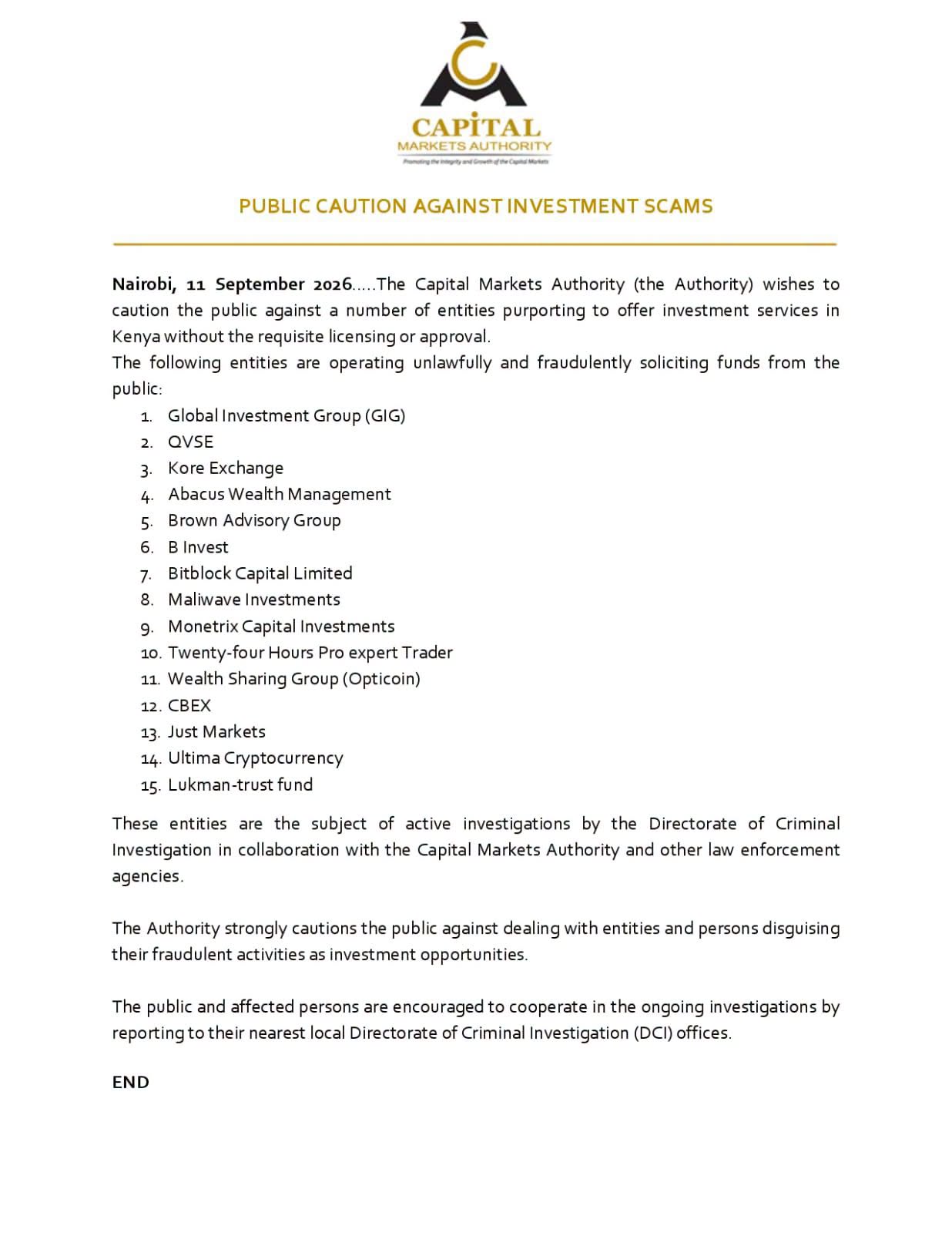 Nigeria’s securities regulator had publicly warned about CBEX in April 2025. Ghana’s regulator named QVSE in July 2026.
Kenya needs an accountable route from those warnings to a domestic assessment, a decision and advice the public can use. Telling investors to exercise caution leaves them doing the work of connecting information that public institutions are better placed to assemble.
The warning had already crossed a border.
On 17 April 2025, Nigeria’s Securities and Exchange Commission said CBEX and its affiliates had never been registered to solicit investment or operate a digital-asset exchange in its market. Its preliminary investigation described unrealistic guaranteed returns, failed withdrawals, and abruptly closed offices.
A second Nigerian alert, signed on 10 June 2025, described reports of renewed operations. Subscribers were reportedly being asked for another US$100 or US$200 before withdrawals could be processed, depending on their balances. The SEC reiterated that the operation was unauthorised and said enforcement action had begun.
For someone trying to recover savings, a further payment can look like the last affordable step towards getting everything back. The original investment decision becomes a recovery decision. A person who would refuse a fresh speculative offer may still pay to release money they believe is already theirs.
An effective warning must reach that person too. Advising people not to invest addresses the first deposit. Explaining demands for additional withdrawal payments may prevent the next loss.
Ghana’s Securities and Exchange Commission included Quant Vest Stock Exchange among 23 unlicensed entities in a notice dated 22 July 2026. QVSE appeared in the Kenyan notice just over seven weeks later. The interval between Nigeria’s April CBEX warning and the September Kenyan notice was nearly seventeen months.
Those intervals measure publication dates, not the duration of an investigation or proof that Kenyan officials ignored an earlier alert. Establishing responsibility requires the dates on which agencies received information, verified its connection to Kenya and decided what to do.
The public should be able to establish that sequence without waiting for another collapse. A regulator can explain when it assessed a warning and what protection it offered without exposing witnesses or publishing its investigative evidence.
One platform, several official doors.
A customer encounters an app, a promoter and a place to send money. The authorities may encounter an investment offering, a payment service, personal-data processing and a suspected criminal offence.
Specialisation has a purpose. Investment supervision requires different expertise from tracing stolen funds or investigating misuse of personal information. Kenya’s Virtual Asset Service Providers Act, which took effect on 4 November 2025, itself assigns regulatory responsibilities to both the Central Bank and the CMA according to the services involved.
But institutional boundaries should not become the complainant’s problem. A person reporting a missing investment should be able to describe what happened without first determining its correct legal classification.
Ninette Mwarania, a planning, policy and research manager at the Competition Authority of Kenya, has described consumers moving between regulators because they cannot identify the appropriate route to redress. In an analysis published by the authority, she also identifies weak information-sharing between agencies and advocates a unified consumer-protection framework with clear timelines and reporting arrangements.
A shared complaint reference would let an investor submit receipts and messages once. Authorised investigators could then record referrals and connect related complaints without repeatedly asking the victim to reconstruct the same experience.
That would also help distinguish the identities surrounding an operation. A trading name, website address, incorporated company and payment recipient may be different. Matching a familiar name alone risks missing an impersonator or wrongly implicating a legitimate business.
A certificate of incorporation establishes a company’s legal existence. It does not establish permission to offer every financial service advertised in its name. Equally, the availability of a bank transfer or mobile-money payment does not mean the payment provider has approved the investment.
An investor needs to verify the actual operator and the permission covering the actual product.
Another database will not be enough.
A global warning service already exists. In March 2025, the International Organization of Securities Commissions launched the International Securities & Commodities Alerts Network, known as I-SCAN. It allows investors, banks, online platforms and other institutions to check alerts published by financial regulators worldwide.
Kenya therefore does not need to begin by building a rival collection of foreign notices. It needs to turn relevant alerts into assigned work.
A foreign notice should prompt checks of the operator, its local activity and its licensing position. The reviewing agency should record whether the notice concerns the same business, a clone using its name or a service governed differently in Kenya. Where another authority must act, the referral should have an identified recipient and a deadline.
Publishing an alert somewhere online is different from reaching a person about to pay. Once a warning has been verified, banks, payment providers and advertising platforms could help place it closer to the transaction or promotion. That might mean an additional check on a flagged recipient or a warning alongside a verified fraudulent advertisement.
An allegation should not automatically freeze an account or remove a lawful business from the internet. Any restriction needs proper authority, proportionate grounds and a route to challenge mistakes. Faster protection depends on accurate identification as much as speed.
Nor should a common complaint system become a public list of everyone accused of wrongdoing. Receipts, identity documents and witness accounts belong in a controlled investigative record. Public information should distinguish verified licensing status, official warnings and concluded action.
Put someone on the clock.
The practical reform is a common intake route with a named agency responsible for coordinating each case. Specialist bodies would retain their powers. The investor would retain one reference number and a way to find out whether the complaint had been received, referred or closed.
The agencies should publish response standards for assessing credible warnings and escalating urgent cases. Their performance reports should show how long referrals take, how many remain unresolved and what happened after action was initiated. Counting public notices alone rewards publication without establishing whether it prevented further losses.
Where lawful grounds exist, early coordination with payment providers and investigators can help preserve records and pursue funds before the trail becomes harder to follow. An eventual prosecution and recovery of an investor’s money are separate outcomes. Victims need honest updates on both.
Financial education remains necessary. So does skepticism towards guaranteed returns and pressure to recruit friends. But public protection cannot depend on every Kenyan becoming an expert in foreign registers, corporate identities and overlapping mandates.
Legitimate investment firms also pay for this failure. They must persuade customers that licensing and compliance offer more protection than a polished website and a persuasive introduction. A system that makes those differences easy to verify gives responsible businesses something tangible to compete on.
The next Kenyan considering a transfer should be able to find out who is receiving the money and whether that business is authorized to offer the investment. If an official warning already exists abroad, someone in Kenya should be responsible for assessing it.
Investors are told to do their homework before paying. The institutions charged with protecting them should be able to show when they did theirs.

Martin Mururu
Martin Mururu is a Kenyan writer and technology professional covering fintech, banking, entrepreneurship, technology and African business. His work examines how innovation, leadership and changing business models are reshaping African markets, alongside profiles of the executives and entrepreneurs building them.
Precursor is published by the FinTech Association of Kenya and exercises independent editorial judgement under the Editorial Independence Charter. This article is labelled First Reading: no commercial party reviewed it before publication.
Housing Levy: Kes206 Billion Later, No One Can Trace a Payslip to a Front Door
Kenya's Affordable Housing Levy has raised Sh206.46 billion in three years. What the public record does not show is where it went, when it ends, or what a contributor is owed.
Housing Levy · 11 min read