Uber rebuilt in Denmark. African cities need platforms built to stay.
Uber’s exits from Tanzania, Nigeria and Uganda expose a weakness in ride-hailing that an app cannot solve alone. Fares must cover the full working journey, and a platform that leaves must account for the people who built its market.

Pool - Uber
The two decisions were separated by 16 months. Uber acquired Dantaxi, Denmark’s largest taxi operator, in May 2025. On 2 September 2026, it stopped taking rides in Nigeria and Uganda. It had already ended its Tanzanian service in January. The company said the September closures followed a review of where its investment could create the greatest value and scale. It did not disclose what those three businesses earned, lost or would have required to continue.
Uber has the right to allocate its capital. Drivers who organized their working days around the platform and passengers who relied on it also have interests in how that decision is carried out. A notice issued on the day a service ends leaves them to absorb a commercial choice they did not make. Uber said rider support would remain available for 21 days after the Nigerian and Ugandan shutdowns. It disclosed no count of affected drivers or customers.
Cars continued to take bookings on other platforms in Lagos, Kampala, and Dar es Salaam. Uber itself said the Nigerian and Ugandan decision was limited to those markets. Transport demand survived its exit. Uber has not published the fares, driver supply, local operating costs and expected returns behind its decision to stop serving them.
As the association representing Kenya’s fintech ecosystem, FINTAK cannot treat ride-hailing as somebody else’s transport problem. Ride-hailing relies on digital payments, identity checks, insurance, customer records, platform credit, and a growing market for driver finance. A driver whose app income cannot support the car is also a poor prospect for the lender financing it. A passenger whose agreed fare changes at pickup loses confidence in a digital transaction. The reliability of the ride rests on the reliability of the system beneath it.
The market Uber could not command.
In Nigeria, Uber’s rider app lagged well behind its competitors. Sensor Tower estimated that Bolt’s Nigerian app had more than 3.3 million weekly active users at its peak in mid-December 2025. Uber’s rider app passed 500,000 at its peak in the same period; inDrive reached about 1.2 million. These are estimates of app activity across iOS and Android, not completed rides, revenue, or profit. Uber had a far smaller observed audience than either rival.
A platform with more nearby drivers can usually offer faster pickups. Faster pickups attract passengers, who generate more trips for drivers. A weaker network can offer discounts or driver incentives to close the distance, but it must finance them. Each driver who keeps several apps open can accept the best available trip regardless of which company recruited them first. A logo on a car does not guarantee that company’s next booking.
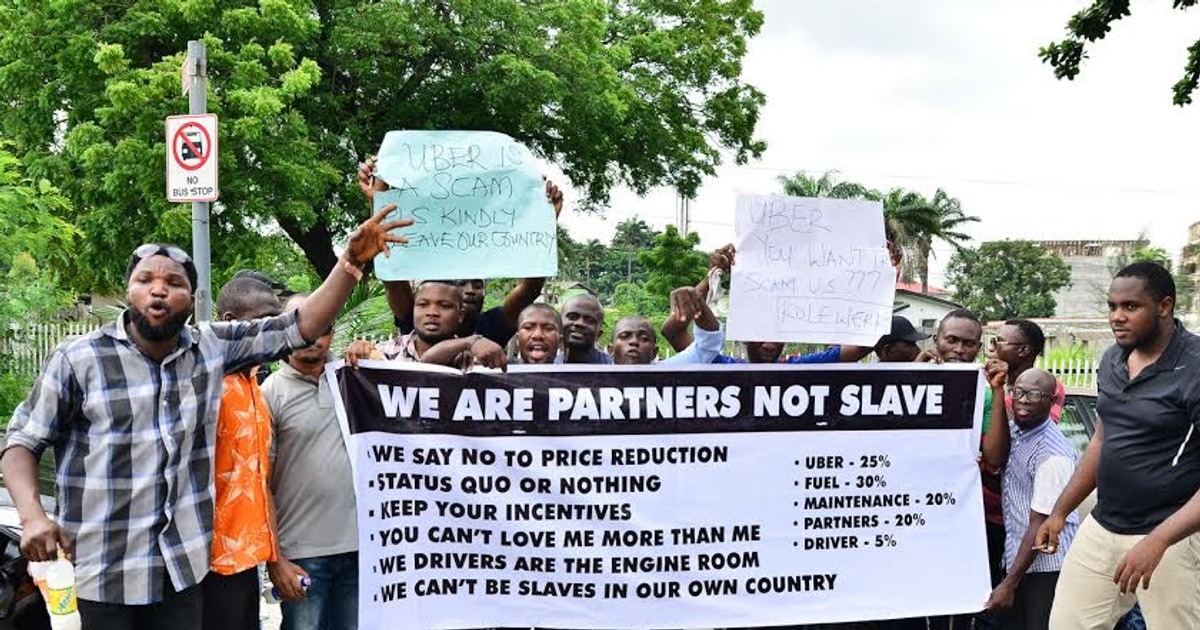
Drivers were already objecting to the economics across the industry. In March, Sanmi Ademujimi joined a protest outside the Lagos State House of Assembly. He told Reuters that a ride could pay 1,500 naira when a litre of petrol costs 1,300 naira. He and other drivers named Uber, Bolt, and InDrive. His comparison was not a calculation of petrol used on a single trip. Fuel, empty running, and vehicle costs all have to be recovered from paid journeys.
An Abuja Uber driver, Abbas Olamide, gave Deutsche Welle a different illustration. A 30,000-naira airport fare could leave 24,000 naira after a 6,000-naira platform deduction before petrol, airport charges, parking, vehicle costs and an empty return. His account is not a national commission schedule. The platform’s deduction must pay for its own operations before it becomes profit.
The pressure intensified as Nigeria’s fuel and imported vehicle costs rose and the naira weakened after the 2023 exchange-rate changes. Yet rising costs alone cannot explain why Uber left while rivals stayed. Competitors faced the same petrol stations and much of the same economy. Their larger networks, different fares, commissions, vehicle requirements or investors’ expectations may have changed the calculation. None has published comparable country accounts that would prove which model is sustainably profitable.
Uber has not said that its Nigerian app share, drivers’ complaints, or the cost of fuel caused its exit. It expressly denied that a recent airport directive was the trigger. Uber faced intense competition for passengers and drivers in a market where the full cost of a trip was hard to recover. Its global management then chose to place capital elsewhere.
The journey the app does not price.
An algorithm can quote a passenger for the distance between pickup and destination. The driver may travel to that pickup without a passenger, wait in traffic, and leave the destination without another fare. The car still consumes fuel and wears out during those unpaid kilometres. Insurance, tyres, maintenance, and financing bills arrive whether or not the app found enough rides that day.
Uber’s app-led model relies on enough completed trips to pay for two businesses at once, the driver’s vehicle and the platform’s dispatch, support and technology. The company can operate without owning most of the cars, but their financing and upkeep remain in the fare. Drivers using several apps and passengers booking directly disperse journeys a single platform would need to recover its costs. A cash button or motorcycle category cannot settle that arithmetic.
A 2025 International Transport Workers’ Federation report drew on a survey of 130 ride-hailing car and motorcycle workers in Nairobi the previous year. Workers told researchers that algorithmic fares could fail to cover pickup distance, waiting time and empty travel between trips. Some described bargaining for more when the quoted fare would not meet their earning target. The Nairobi sample predates Uber’s withdrawals. An occupied-ride fare must also recover unpaid kilometres and time if drivers are to cover the full working day.
Cutting commission gives the driver a larger share of the same fare. It does not create a passenger for the empty trip or pay for a new set of tyres. Raising fares may cover more costs, but customers can switch apps or use another form of transport. Discounts can hold down the passenger price while maintaining the driver’s receipt, but the company pays the difference until the promotion ends. Cheap rides, decent driver earnings and a profitable platform have to be funded by the same stream of completed journeys.
The costs also explain why fare negotiation keeps returning after an app claims to have abolished it. SafeBoda’s Uganda country director, Christian Wamambe, says drivers on ride-hailing services had asked passengers to pay more than the displayed price. SafeCar promises that the fare on its app will stand and says it does not apply surge pricing. inDrive instead lets a passenger and driver propose and counter a price within the app before either commits. Neither can sustain a fare that leaves too many drivers unable to cover their costs.
Kenya’s YEGO tests a different boundary. It says a customer can order in the app, call a centre or flag a participating vehicle and record the journey on a meter. A street hail already has a passenger beside a driver. Recording it can bring the fare, payment and work history into a system without making the passenger first download an app. A phone agent can serve someone without mobile data or guide a driver by a local landmark. The call centre, verification, and support cost money. They also open journeys an app-only platform may never see.
Their public claims do not include comparable audited accounts of the full businesses. No rival earns a policy preference simply by keeping its booking button active. African fit depends on operating design rather than the nationality of a company’s owners. Dispatch, payments, driver earnings, support, safety and finance must work together after the promotional money is spent.
The Danish choice.
Uber has withdrawn from Europe too. It left Denmark in 2017 after a taxi law imposed requirements it said its service could not meet. It returned to Copenhagen in 2025 and then acquired Dantaxi. Under the arrangement Uber announced, the local company remained the licensed taxi operator, professional drivers supplied the rides and fares followed Danish taxi rules. Uber supplied the app, dispatch technology and demand.
Uber changed the institution behind the app, not just a payment option within it. It invested in an established fleet and accepted regulated fares to regain the market.
Denmark did not give Uber a free hand in exchange for its return. In August 2026, the Danish Competition Council approved the Dantaxi acquisition only after Uber committed to sell a substantial part of the business. The authority identified risks of higher taxi prices, worse terms for taxi operators, and barriers to new entrants. Its remedy covers a dispatch centre, customer-booking channels, and agreements with vehicle operators. Uber remained in the market under tighter controls on its market power.
Danish fares, vehicle costs, regulation, and purchasing power differ from those of Lagos or Kampala. An acquisition that works in Copenhagen might fail elsewhere. Uber’s response there still shows that a global platform can change its partnerships, licensing structure and economics when it judges the market worth rebuilding. Africa should not be told that one imported configuration is the only way to receive its service.
Uber has made African adaptations. It introduced cash payment in Kenya in 2015, Uber Boda in 2018 and in-app M-Pesa payment in 2023. In Tanzania, it suspended services in 2022 after the regulator capped commission and constrained fares, returned when the terms changed, and operated for roughly three more years. The company has not attributed its January 2026 closure to that earlier dispute. Cash, motorcycles, and mobile money made the app more usable. They did not change who financed the car or paid for its empty kilometres. Uber has disclosed no comparable rebuilding of the operating business in the three markets it left.
The cost of an exit.
On the day Uber closed in Nigeria and Uganda, chief executive Dara Khosrowshahi announced a roughly 10 percent reduction in the company’s global workforce. He said Uber would focus people and investment on its largest opportunities. Its worldwide accounts for the preceding quarter showed $58.0 billion in gross bookings, $1.9 billion in operating income and $2.8 billion in free cash flow. Those figures say nothing about the profitability of the three departed countries. They do establish that this was a choice by a cash-generative global group, not the disappearance of the company itself.
A platform may leave a market it cannot sustain. FINTAK’s position is that a platform which has recruited drivers, collected customer histories and become part of daily transport should leave through an orderly process. Drivers need their outstanding earnings settled, a usable record of completed trips and deductions, and a clear route for unresolved complaints. Passengers need notice, refunds where owed, access to their records and a stated period for support. Local employees and partners need the terms of transition. These obligations should be designed in advance, not improvised on the day a booking service stops.
That standard should apply to African-owned and foreign-owned operators alike. It should be proportionate to the scale of the service. A small entrant testing one city cannot carry every obligation of a multinational platform. A large intermediary with substantial driver and customer relationships must provide a transition when it closes.
Local companies also deserve scrutiny rather than applause for staying. A lower commission funded by venture capital can end when the funding does. A driver-credit product built on gross app receipts can leave borrowers exposed if their net income after vehicle costs is inadequate. Capturing street hails may improve utilization while weakening passenger protection unless the trip is recorded and support remains available.
The choice facing Kenya.
On 1 September, Kenya’s High Court declared the 2022 transport-network regulations procedurally invalid while suspending the general declaration for 12 months to allow new rules. It barred interim enforcement of the 18 percent commission cap and specified data-surrender provisions against the petitioner and digital transport operators. The court required fresh public participation and a regulatory impact assessment. Uber has announced no plan to leave Kenya.
The government should use that assessment to examine the cost of an actual working day. It needs data on passenger fares, platform deductions, driver receipts, time and distance spent reaching pickups, empty returns, cancellations, and vehicle expenses. It should test what happens to availability and customer prices when those amounts change. A commission ceiling alone cannot tell a driver whether a fare will replace the vehicle being worn out. Removing the ceiling alone cannot guarantee a better income either.
Driver representatives, consumer advocates, platforms, insurers, vehicle financiers and payment providers belong in that assessment. Vehicle financiers need to know what a driver earns after operating costs. Insurers need reliable trip records. Passengers need a fare they can trust and a route for complaints. FINTAK’s role is to press for a digital market in which the people financing, providing, and buying a service can see how the money moves.
Uber returned to Denmark with a locally licensed operator and accepted a competition remedy when its investment threatened to narrow choice. It left Nigeria and Uganda on the day it announced the decision. African governments cannot compel every global company to stay. They can require an orderly exit, reject rules made without economic evidence, and give better-designed competitors room to serve the journeys that remain.
The next successful platform in Lagos, Kampala, or Nairobi will have to earn its place on the road. The fare agreed with the passenger must pay for the driver’s whole working journey and for the service that makes the trip safe and dependable. If it cannot, the app will eventually lose either its drivers, its passengers or the capital behind it.
The Precursor Editorial Team
Precursor is published by the FinTech Association of Kenya and exercises independent editorial judgement under the Editorial Independence Charter. This article is labelled Opinion: no commercial party reviewed it before publication.
If M-PESA Took a Week Off, Kenya Would Discover We Have a Problem.
M-PESA has become so reliable, familiar and deeply woven into everyday life that Kenya rarely stops to ask what happens if the bridge everybody uses suddenly closes. A hypothetical seven-day outage turns that question into a very Kenyan comedy of cash shortages, stranded payments and improvised solutions, while exposing a less amusing truth about what happens when an economy becomes too dependent on one payment rail.
Payments · 10 min read