Kenya's Data Market Is Repricing Against the People Who Buy Small
Safaricom and Airtel Kenya have reshaped their data menus in opposite directions, cutting the effective cost of mainstream monthly connectivity while reducing or restricting the small, short-duration bundles used by customers with irregular incomes. The result is a widening affordability divide in a market where two operators control more than 96% of subscriptions: planned, high-volume internet access is becoming cheaper, but the smallest unit of connectivity is becoming more expensive, less flexible and, at key hours, harder to buy.

On the morning of Monday 10 August 2026, a Safaricom customer named Samuel Waititu wrote to the company on its own social feed in the register Kenyans reserve for institutions that have disappointed them. "Safaricom imeanza kubore," he wrote. "Make ur bundle ya 1hr mumeondoa. Data B-Live hakuna." Safaricom has begun to deteriorate. You have removed the one-hour bundle. There is no Data B-Live.
Safaricom's reply, published the same day, was courteous and empty: "Sorry to hear about your experience, Sammie. We have taken your feedback to help us serve you better." It did not say whether the product had been withdrawn, restricted, or repriced. Safaricom confirmed the position later: "Only one B-Live offering, Sh25/= will be available on the menu every day between 23.00Hrs to 16.00Hrs going forward."
Eight days later, Airtel Kenya subscribers dialled *544# and found something more straightforward. Every tier of Smarta, the integrated package that had been Airtel's principal weapon against Safaricom since February 2025, still cost exactly what it cost on Sunday. Smarta 1500 still cost KSh 1,500. It now contained 32GB rather than 90GB.
Neither event was announced as a price increase. Neither was one, if price means the number printed next to the shilling sign. Each raised the effective cost of connectivity for the customers affected by between 25 and 181 percent. And in the same three weeks Safaricom cut the effective price of its mainstream monthly bundle by more than half.
The two movements are one movement. Planned, monthly, high-volume connectivity has become dramatically cheaper; small, occasional, time-bound connectivity has become dearer and, in places, unavailable. In an economy where 83.8 percent of employment is informal, that is a change in who can afford to be online and when.
II. What actually changed, tier by tier
Airtel Kenya: Smarta, 18 August 2026
Airtel Kenya's own website, checked on 21 August 2026, lists the current Smarta menu. Reporting published on 18 August recorded the allocations it replaced.
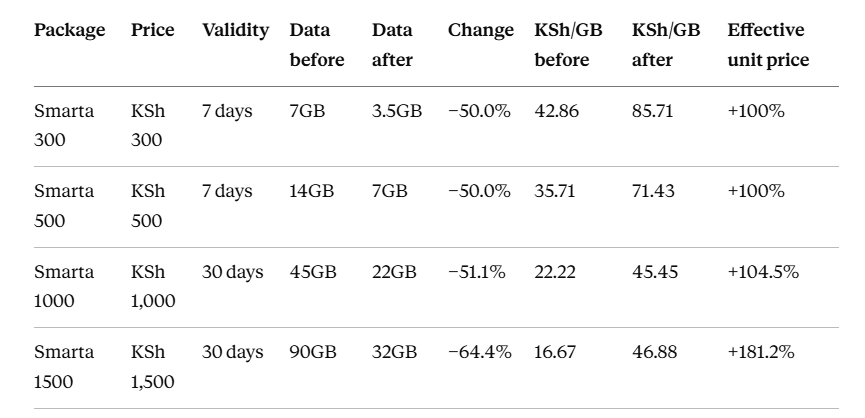 Smarta is an integrated product, so attributing the whole price to data overstates the data component; the per-gigabyte figures are an index of value, not a data tariff. The non-data components were cut too, so the overstatement runs the same way in both columns: on-net minutes on Smarta 300 fell from 100 to 50 a day, Smarta 500's off-net SMS allowance fell from 1,250 to 350, a reduction of 72 per cent, and Smarta 1500's on-net minutes fell from 3,000 to 1,000. The bundle lost across every dimension it sold. Published accounts of the new Smarta 300 also differ, one giving 3GB and another 3.5GB; Airtel's own page gives 3.5GB, and that is used here. No public register exists to settle the difference.
On the same day it cut Smarta, Airtel launched Jiachilie, a data-only range at 2.4GB for KSh 99 daily, 5GB for KSh 250 weekly and 25GB for KSh 1,000 monthly. A customer at KSh 1,000 for thirty days who wants maximum data can still obtain 25GB, against 45GB under the old Smarta 1000: a reduction of 44.4 percent in the best offer at that price, not 51.1 percent. This is a portfolio restructuring that migrates customers out of generous integrated bundles into leaner data-only ones, with a material net reduction in value at every tier.
Safaricom: two changes pulling in opposite directions
Safaricom moved in two directions at once, three weeks apart.
On 31 July 2026 the company launched a campaign named Pata More. Chief executive Peter Ndegwa announced it in the language of responsiveness: "We understand that every choice our customers make matters. That is why we continue to listen closely and respond with practical, everyday value."
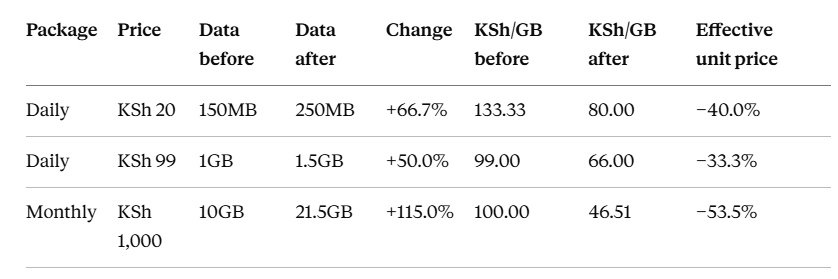 A customer buying a thirty-day bundle at KSh 1,000 now pays less than half what she paid in July for each gigabyte. Safaricom's published terms, last updated 3 August 2026, give that bundle as 21GB rather than the 21.5GB in the campaign announcement, a discrepancy between a company's marketing and its own contractual documentation that would be trivial if the documentation were not the only public record.
Simultaneously, and without a campaign, the short-duration end contracted. B-Live, launched in August 2025, sold time rather than volume: KSh 20 for one hour, KSh 30 for 1.5 hours, KSh 50 for three, KSh 75 for 4.5 and KSh 150 for six, available to all prepay and postpay data customers. Safaricom's own statement confirms a single survivor: KSh 25 for one hour of browsing plus ten voice minutes plus a KSh 1 contribution to Ziidi, the company's money market fund, available only between 23:00 and 16:00.
The change did three separate things. The one-hour product rose from KSh 20 to KSh 25, an increase of 25 percent, offset by ten voice minutes: a modest, defensible repackaging. The multi-hour blocks were withdrawn, and at KSh 50 for three hours a customer had paid KSh 16.67 an hour; with only the one-hour option, she pays KSh 25, an increase of 50 percent in the effective cost of an afternoon online.
The third change does not show up in any per-unit figure. Access is unavailable between 16:00 and 23:00. Seven hours have been removed from the day, and they are the seven in which a boda boda rider finishes a shift, a student opens a laptop, a trader posts stock to WhatsApp Status and a household watches a match. Safaricom has not explained the restriction beyond describing the exercise as "a review of data bundles". A network-management rationale is entirely plausible: the evening peak is where congestion lives, and an effectively unmetered hourly product is the worst instrument to sell into it. Safaricom has not made that argument.
Safaricom's algorithmically personalized offers, the deeply discounted bundles that appeared on individual customers' menus, were suspended during 2026. The company has published no account of how many customers held them, why they went, or whether they return.
The convergence
The KSh 1,000, thirty-day price point is where the two menus now meet.
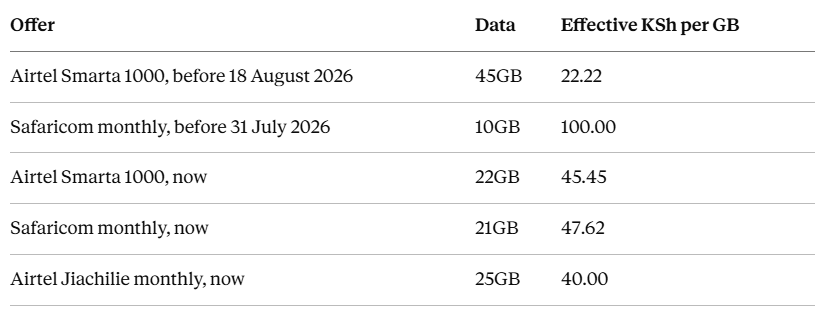 Three weeks apart, moving from opposite directions, Kenya's two largest operators arrived at effectively the same price. Safaricom improved from KSh 100 per gigabyte to roughly KSh 47. Airtel retreated from KSh 22 to roughly KSh 45. The gap between the market leader and its only serious challenger at this price point, a factor of 4.5 in July, is now about two shillings.
There is no evidence of coordination between Safaricom and Airtel, and none is alleged here. The sequencing is consistent with unilateral response: Safaricom improved its mainstream bundles first, and Airtel, whose entire proposition rested on undercutting Safaricom by a wide margin, discovered it no longer needed to undercut by so much. That is parallel commercial behaviour of the kind competitive markets produce, and it is not coordinated behaviour. Only the latter would raise a competition-law question, and no evidence of it exists.
But the consumer consequence does not depend on which explanation is right. Whether by competition or by convergence, the market has moved from a structure in which one operator offered a dramatically cheaper alternative to one in which both offer approximately the same thing.
III. Why the smallest bundle is the most important one
Kenyans call this the kadogo economy, the economy of the small quantity. It describes a liquidity condition rather than a taste.
The Kenya National Bureau of Statistics recorded 18.1 million people in informal employment in 2025 against 3.31 million in formal wage employment, 83.8 percent of all jobs. Those 18.1 million are not paid on the twenty-fifth of the month. They are paid when a fare is completed, a customer buys or a harvest sells. Real wages for the formal minority, indexed to a June 2009 base of 100, stood at 85.84, meaning a salaried Kenyan earns materially less in real terms than one did seventeen years ago.
This is why Kenyans buy cooking oil by the spoon, electricity in prepaid tokens and transport by the trip. It is not a cultural preference for small quantities but a rational response to a liquidity constraint. A household with KSh 300 today and an uncertain KSh 300 tomorrow cannot pre-commit KSh 1,000 for thirty days, however attractive the per-unit price. The binding constraint is not the price of the gigabyte. It is the size of the smallest purchase that unlocks any gigabyte at all.
An hourly bundle removes the commitment premium entirely. It converts connectivity from a capacity purchase into a time purchase at a price payable from a single fare. A rider who needed maps and WhatsApp for the three hours between 17:00 and 20:00 could, until this month, buy exactly that from Safaricom for KSh 50. She now cannot buy it from Safaricom at any price, because the product does not exist in that window. She can buy it from Airtel, which still lists hourly bundles at KSh 15 for 250MB between 16:00 and 22:59 and KSh 15 for 1GB between 23:00 and 15:59. Competition therefore still disciplines product architecture in this market, even where it has stopped disciplining per-unit price.
Kenya had 62.6 million mobile data subscriptions and 52.9 million mobile broadband subscriptions in the quarter to March 2026, and total mobile broadband consumption of 800,027,716 gigabytes, which is 15.1GB per subscription per quarter, or roughly 5.0GB a month. Safaricom's audited figure for the year to March 2026 puts consumption per chargeable subscriber at 4.92GB a month, up 16.6 percent. The two figures, derived independently, agree: the typical Kenyan mobile internet user consumes about five gigabytes a month, not fifty.
Safaricom's chief financial officer, Dilip Pal, told investors: "Customers who are not using 1GB in a month represent a huge opportunity." Roughly half of Safaricom's mobile data subscribers consume less than one gigabyte a month. For them, the hourly bundle, the personalized offer, and the KSh 20 daily are not marginal products. They are the entire product.
IV. The operators' case, and what the accounts show
Mobile data is a business in which unit prices fall relentlessly while volumes rise, and the operator's task is to ensure that volume exceeds the decline in prices. In FY2026 Safaricom's mobile data revenue of KSh 83.4 billion, up 14.4 percent, overtook voice revenue of KSh 81.8 billion for the first time in the company's history, achieved while the realized rate per megabyte fell 12.1 percent to 5.44 cents. Cost pressure is real alongside it. Kenya levies an excise duty of 15 percent on telephone and internet data services, and network electricity, off-grid diesel, tower leases, imported electronics, and international bandwidth are all dollar-linked.
On that account, a package offering 90GB for KSh 1,500 was never a tariff. It was a customer-acquisition subsidy funded by shareholders, deployed to win share against a competitor holding seven subscribers in ten. Withdrawing a subsidy is not raising a price, and treating launch pricing as a permanent obligation would guarantee that launch pricing never happens again.
The defence holds better for Airtel than for Safaricom.
Airtel Africa's East Africa segment, dominated by Kenya, reported revenue of $607 million in the quarter to June 2026, up 14.4 per cent in constant currency. Data revenue of $269 million rose 29.7 per cent, data customers rose 16.8 per cent to 37.8 million, and consumption per customer rose from 8.8GB to 11.9GB a month. Segment capital expenditure was $138 million, an increase of 220.5 percent, and operating free cash flow fell 15.8 percent to $157 million as investment outran EBITDA gains. A company spending three times as much on its network while its customers consume 35 percent more data each has an evidenced reason to reprice. Segment EBITDA margin, nonetheless, rose 252 basis points to 48.7 percent in the same quarter, and group profit after tax for the year to March 2026 tripled to $813 million.
In the year to March 2026 Safaricom's Kenyan EBITDA margin rose to 56.8 percent, capital expenditure fell 18.4 percent to KSh 74.5 billion, and the declared dividend rose 66.7 percent to KSh 80 billion. Capital intensity is falling, margin is expanding and distributions are rising sharply. A company in that position may still be harvesting a completed investment cycle, but it cannot ground the B-Live restriction in investment need. The congestion explanation survives, and Safaricom has not offered it. On 1 August the company announced 300 additional masts, taking a current rollout to 500 sites in areas with limited coverage, which is what a congestion constraint calls for and what a company withdrawing a congestion-sensitive product would ordinarily say.
The same mechanism appeared in the group's other market eight months earlier. In December 2025 Safaricom Telecommunications Ethiopia cut a daily bundle from 150MB to 100MB at an unchanged 5 birr and a weekly bundle from 10GB to 5.5GB at an unchanged 250 birr, with reported increases across the portfolio of 20 to 82 percent, citing operating costs, foreign exchange shortages and imported technology. Shrinking the denominator rather than raising the numerator is a repeated group practice, not a Kenyan accident. In Ethiopia, unlike in Kenya, the company explained itself publicly.
The surviving KSh 25 B-Live includes a KSh 1 contribution to Ziidi, Safaricom's money market fund. A connectivity product that cannot be bought without simultaneously buying a regulated financial instrument is a tied sale, engaging both the Communications Authority and the Capital Markets Authority. Neither has said anything publicly.
V. What the rules require, and what nobody records
Under the Kenya Information and Communications (Tariff) Regulations 2010, licensees file tariffs with the Authority; tariffs for regulated services, meaning those in uncompetitive markets or where a licensee is dominant, require prior approval, while tariffs for unregulated services may be filed for information. Regulation 11 deals separately with promotions. This is a regime of filing and, where dominance applies, approval. It is not a regime of advance consumer notification. The Consumer Protection Regulations 2010 come closer: Regulation 10(1) requires a clear and understandable description of services, rates, terms and charges; Regulation 10(3) requires point-of-sale disclosure of the provisions used to calculate charges; Regulation 20(2)(d) requires billing systems to disclose any rate or service charge to be implemented within the next billing cycle.
Safaricom's own bundle terms reserve the right to "modify, vary, amend or withdraw this service", with notification via media or website. Airtel's advance communication before 18 August, as reported, was a text message four days earlier confirming that existing resources would not be affected, which is true and is not the same as saying future purchases would contain half as much.
Can a Kenyan operator reduce the data sold at a given price without telling the customer that the economics of the product have changed? Substantially yes. A promotion may expire. A personalized offer may cease to be extended. A bundle may be varied under a contractual right, with notice given by publication. Each is a different legal event, and none requires the company to state explicitly that a gigabyte now costs twice what it did yesterday. Nothing in the law prevents an operator from publishing the effective price per gigabyte alongside the headline price, giving fourteen days' notice of a material reduction in allocation, or maintaining an archive of superseded terms. Operators do not, because nobody requires it.
The Communications Authority publishes excellent quarterly sector statistics. It does not publish a historical tariff archive. There is no authoritative, time-stamped record of what a KSh 500 bundle contained in January 2026 or on the day before it changed. Operator websites are overwritten; terms and conditions carry a "last updated" date but no version history. When two respectable outlets reported the new Smarta 300 as 3GB and 3.5GB, there was no register to consult. A market in which the historical price is unrecorded is a market in which price changes cannot be measured, by consumers, researchers, regulators or investors.
Where offers are individually generated and algorithmically targeted, there is no such thing as "the price" of a bundle. There is only the price offered to a particular handset at a particular moment, and the customer beside you may be looking at a different menu. This is a legitimate and increasingly standard technique. It also renders the published tariff, which the 2010 regulations assume, close to meaningless. The framework was designed for printed price lists; the market has moved to individually computed offers, and the framework has not followed.
Kenya, which built the world's most studied mobile money system and publishes some of Africa's most granular telecommunications statistics, could maintain a public archive recording price, allocation, validity, eligibility and terms for every mass-market product, with effective dates. The cost would be trivial. The disciplining effect would not.
VI. Two firms, and no third force
The Authority's figures for the quarter to March 2026 describe 84.1 million mobile subscriptions, of which Safaricom holds 57.9 million, or 68.9 per cent, and Airtel 23.2 million, or 27.6 per cent. Telkom Kenya has 584,438 subscribers, 0.7 percent, having lost 160,464 in a single quarter; Equitel holds 1.8 percent and Jamii Telecommunications 1.1 percent. Safaricom carries 62.7 per cent of mobile broadband subscriptions and 89.1 per cent of mobile money subscriptions.
Two operators account for 96.5 per cent of the market. When the challenger's product architecture converges with the incumbent's, as it did in August, there is no third force to arbitrage the difference, and for most Kenyans there is no fixed-line substitute either: fixed data subscriptions stood at 2.66 million against 52.9 million mobile broadband subscriptions, and the National Broadband Strategy 2025 to 2030 records rural internet penetration of 25.0 per cent against 56.5 per cent in towns. For the household outside a fibre footprint, the mobile bundle menu is not one option among several. It is the market.
VII. Meanwhile, fibre is moving the other way
While mobile economics tightened at the small end, prices in fixed broadband fell.
The nPerf barometer for the twelve months to 31 March 2026, based on crowdsourced tests and covering the five ISPs with more than a 5 per cent share of tests, ranked Faiba, operated by Jamii Telecommunications, first with a score of 67,150 and an average download of 62.68 Mb/s, an 89 per cent improvement year on year. VGG Connect placed second on 59,321, Safaricom third on 55,978, Zuku fourth on 53,181 and Airtel fifth on 41,438. VGG Connect recorded latency of 14.20 milliseconds, best in the market for a fifth consecutive year.
The tests are self-selected, measuring customers motivated to run a speed test rather than a representative sample, with test share ranging from Faiba's 41 percent to Zuku's 7 percent. They also reflect the packages customers actually buy rather than network capability: VGG Connect's average download of 21.36 Mb/s, the lowest of the five, sits alongside the best latency in the market, which is most consistent with a well-engineered network serving customers who predominantly buy low-speed tiers.
Safaricom raised Home Fibre speeds in April 2026, taking Bronze to 40 Mb/s at KSh 2,999 and Gold to 150 Mb/s at KSh 6,299, with 25 per cent promotional discounts for new connections. Zuku discounted in August to KSh 2,099 for 30 Mb/s and KSh 3,099 for 100 Mb/s. And Savanna Fibre, a 2024 entrant with sister operations in Uganda and Tanzania, launched 100 Mb/s at KSh 2,000 a month with free router and installation.
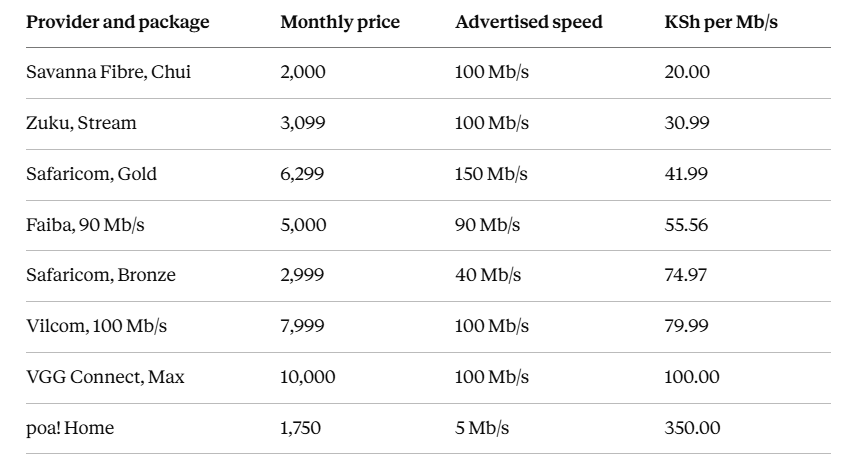 Cost per advertised megabit says nothing about contention, uptime, latency, upload symmetry, support or whether the advertised speed exists in the evening. Safaricom's Home Fibre uses GPON architecture in which a single fibre line is shared between 32 and 64 households, and the company has acknowledged capacity constraints in dense estates including Roysambu, Kitengela and Embakasi, where customers report video quality dropping between 19:00 and 22:30. A cheap megabit that is not there at eight in the evening is not cheap.
Why can a new entrant plausibly offer 100 Mb/s for KSh 2,000 when established providers charge two to three times as much per megabit? Promotional acquisition pricing that will revert, lower overheads and thinner support, high contention ratios that make advertised speeds statistical rather than dedicated, wholesale fibre bought at current rather than legacy prices, and, above all, geography. Savanna Fibre's actual coverage at launch was Kilimani, Kileleshwa, Lavington, Langata and Muthangari. Its website claimed fifteen counties; verification found a footprint confined to some of Nairobi's most affluent suburbs. Cherry-picking dense, high-income, low-churn neighbourhoods is a rational entry strategy used by challenger ISPs everywhere. But a KSh 2,000 tariff in Kileleshwa is not evidence that 100 Mb/s can be profitably supplied to a household forty kilometres outside Nyahururu. Density, backhaul distance, acquisition cost and maintenance economics all move against the rural connection, and none of them is a matter of incumbent complacency.
Kenya now has two connectivity markets moving in opposite directions. In perhaps a dozen Nairobi estates a household can choose among four or five providers and pay less each year for more bandwidth. In most of the country a household has one meaningful choice, and that choice repriced in August.
VIII. Price is not affordability
A KSh 2,000 package delivering 100 Mb/s offers an effective cost per gigabyte so low as to be almost unmeasurable. It is also unavailable to a household that cannot assemble KSh 2,000 on a single day once a month. A daily-income earner who can find KSh 70 most days can pay KSh 2,100 a month in aggregate and still be unable to buy a KSh 2,000 subscription, because the payment architecture requires a lump sum she never holds.
The National Broadband Strategy records fixed broadband costing 13.4 percent of GNI per capita against an ITU Broadband Commission target of 2 percent and commits to that target by 2030, explicitly including the bottom 40 percent of the population. Reaching it by lowering the monthly price alone would require a reduction no operator's cost base supports. Reaching it by changing how the price is paid is a different proposition.
poa! Internet, which holds 9.7 percent of fixed data subscriptions across more than 65 locations in Nairobi and Kiambu, sells a 5 Mb/s home package at KSh 450 a week alongside KSh 1,750 a month, and runs poa! Street, a hotspot network offering 100MB free daily and 1GB for KSh 20 with no expiry across more than 40,000 hotspots. On a per-megabit basis poa! is the most expensive provider in the table above. On an accessibility basis it may be the most important, because it is the only one whose payment structure matches how its customers are paid.
Safaricom is moving the same way on fibre. In December 2025 it launched a prepaid fibre plan at KSh 800 a month aimed at households with irregular income, and announced tokenised Wi-Fi with hourly, daily and weekly options. Peter Ndegwa said of it: "Instead of having only monthly plans, you can have daily, hourly, weekly, or monthly. By tiering pricing, we can deliver propositions that expand participation." The company has just over 400,000 fixed broadband customers against a market it estimates at four million households.
Safaricom is therefore building hourly pricing on fibre in the same year it withdrew hourly pricing on mobile between 16:00 and 23:00. The two are reconcilable: marginal capacity on fixed infrastructure is cheap and the binding constraint is customer acquisition, while marginal capacity on mobile spectrum in the evening peak is the scarcest thing the company owns. Safaricom has not said so.
Kenyan ISPs have spent a decade competing on speed. For a household that can already stream, work, study and hold video calls comfortably at fifty megabits, the marginal value of the next four hundred and fifty is close to zero. Speed has largely exhausted itself as a mass-market differentiator; the remaining frontiers are payment flexibility, coverage, evening reliability, contract terms and price transparency. The company that solves how Kenyans pay for fibre, rather than how fast it runs, is likely to open the next several million connections.
IX. The infrastructure Kenya already owns
Two publicly owned assets could carry cheap fixed broadband beyond the affluent estate.
The first is Kenya Power, the principal contractor for last-mile fibre to 53,000 government institutions, deploying along its electricity network and earning KSh 940.6 million in the year to June 2025 against a first phase estimated at KSh 10 billion. The national target is 100,000 kilometres by the 2027 general election; approximately 80,633 kilometres were reported installed by mid-2025.
Aerial fibre on existing poles avoids the largest last-mile cost, trenching, and the utility already holds the rights of way and the pole inventory. That advantage is real and partial: the last mile also requires drop cables, optical network terminals in each home, powered electronics at aggregation points, backhaul, billing, support and maintenance crews for a network struck by vehicles, storms and theft. Pole attachment further requires a commercial and safety regime governing third-party access, which Kenya does not have in mature form. The realistic contribution is to lower the barrier for open-access wholesale fibre in secondary towns, not to make universal fibre free.
The second asset is the Universal Service Fund, financed by a levy of 0.5 per cent of gross revenue on communications licensees. Billions are not idling in it. The 2023 to 2027 strategy requires KSh 40.037 billion; the Authority assessed it could raise KSh 28 billion. Its own framework acknowledges that closing national access gaps would require KSh 74 billion and that at current collection rates this would take up to ten years for voice and forty-seven years for data. The Fund's director, Leo Boruett, said of the published figures: "When you see a figure there, it doesn't mean the money is available. Whatever you have seen is a dream, a wish list." The most recent full audit in the public domain, for the year to June 2019, recorded a qualified opinion and actual expenditure of 53 per cent of budget.
The Fund is in any case designed around coverage: putting a signal where there is none. Kenya's coverage problem is now much smaller than its usage problem. If a household sits inside 4G coverage and is still offline because five gigabytes a month is beyond its budget, a subsidy that builds another mast does not reach it. The question of the next decade is not whether a signal can reach you. It is whether you can afford to use it once it does, and Kenya's principal universal-access instrument is not pointed at that question.
X. Roaming, and the persistence of the toll booth
Roaming pricing outlives the technology and corporate structure that once justified it, and Kenya offers a clean comparison.
Airtel Kenya's published Roam Like Home offer gives 5GB for KSh 1,000 over seven days, or 10GB for KSh 2,000 over thirty, usable across thirteen countries including Tanzania, Rwanda, Uganda and Nigeria. That is KSh 200 per gigabyte abroad, roughly four times what the same customer pays at home.
Safaricom's published East Africa prepay roaming bundles, covering Uganda, Tanzania and Rwanda, offer KSh 2,000 for 120 minutes, 180 SMS and 160 megabytes. These are integrated bundles and the whole price cannot fairly be attributed to data. Safaricom's global roaming bundles are priced at KSh 10,300 for 1GB over thirty days, and its roaming portal advertises data "from Ksh. 5 per mb", which is KSh 5,120 per gigabyte, or twenty-five times Airtel's pan-African rate.
Safaricom Kenya's East Africa prepay roaming terms do not include Ethiopia, notwithstanding that Safaricom PLC is the anchor investor in Safaricom Telecommunications Ethiopia. No published Ethiopia-specific roaming tariff could be obtained, and no figure is asserted here. A Kenyan customer roaming onto a network bearing the same brand, in which her own operator is the largest shareholder, is not offered a home-like proposition; an Airtel customer roaming onto Airtel networks in thirteen countries is.
The two Safaricoms are separately licensed companies with separate regulators, spectrum obligations, tax exposures and shareholders, and traffic between them settles at wholesale rates like traffic between strangers; Ethiopian foreign exchange controls make cross-border settlement genuinely difficult. What is eroding the structure is not regulation but substitution: eSIMs, Wi-Fi calling and cheap travel SIMs have already removed most of the roaming revenue once extracted from business travellers. Airtel's own domestic pricing in August shows that a company can be structurally progressive in one product and sharply regressive in another.
XI. What a more ambitious market would look like
For decades formal banking in Kenya was expensive, branch-centred and organised around salaried customers, and the industry's cost structures were widely understood to make small-balance retail banking unprofitable. Equity Bank showed that this was a fact about how banks were built rather than a law of economics. Kenya's ISPs are not the banks of that era. But industries do routinely mistake an inherited cost structure for an economic constraint until an entrant demonstrates the difference.
Which constraints are real? Backhaul distance, rural density, the capital cost of active electronics and the cost of servicing a customer forty kilometres from the nearest technician are all real. But monthly billing is not a law of physics; it is a billing system. The absence of a tariff archive is not a technical limitation; it is a choice. Contract minimums, installation fees, the requirement to hold a lump sum on a fixed date and the unavailability of an evening hourly bundle are design decisions, and design decisions are what competitive entry attacks first.
The issue is not whether Safaricom and Airtel may change their products. They may, and should be free to. Nor should cheaper internet be confused with free internet: spectrum, towers, fibre, diesel, engineers and capital must be paid for, and an operator that cannot earn a return will not build the next thousand sites. Safaricom's Pata More improvements are evidence that competition delivers real gains, and nobody compelled them.
What is contestable is transparency, competitive breadth and economic design, and each has a practical remedy. A public tariff archive maintained by the Authority, recording price, allocation, validity and terms with effective dates. Mandatory advance notification where an allocation at an unchanged price falls by more than a stated threshold. Price-per-gigabyte disclosure alongside the headline price at the point of sale, which is a labelling requirement, not a price control. A regulatory position on personalized offers, so a market of individually computed prices remains observable in aggregate. Clarity on the tying of financial products to connectivity. An open-access wholesale regime and a workable pole-attachment framework. A Universal Service Fund pointed at affordability, not only coverage. And prepaid, daily and weekly billing for fixed broadband, which Safaricom has begun and its competitors should be forced to match.
None of this is exotic. Most of it exists somewhere.
XII. The customer at the menu
She is not reading a financial statement. She is looking at a list of numbers, and the number she is looking for is not there. What she experiences is not a price rise, because the price did not rise. What she experiences is that the thing she could afford yesterday is no longer for sale, and that the cheapest way to get online now requires a commitment she cannot make. If she is one of the roughly half of Safaricom's data customers who consume less than a gigabyte a month, this is not a marginal inconvenience. It is the difference between using the internet and rationing it.
Airtel's KSh 1,500 package fell from 90GB to 32GB while its price stayed at KSh 1,500, raising the implied cost of each gigabyte from KSh 16.67 to KSh 46.88. Safaricom's monthly KSh 1,000 bundle rose from 10GB to 21.5GB, cutting the implied cost of each gigabyte from KSh 100 to KSh 46.51. Both statements are true, both were made by companies acting lawfully, and the customer who benefits from the first is not the customer who suffers from the second. The household planning a month of connectivity has never had it better. The household buying an hour of it has just lost the seven hours of the day it most wanted.
Kenya solved its first telecommunications problem when it put a mobile phone in nearly every hand. It solved much of the second when mobile money turned that phone into a financial account. The third is making the internet carried by that phone cheap enough, and divisible enough, to use without calculation. It will not be solved by asking two companies to be more generous. It will be solved by a market in which price changes are visible, in which more than two firms compete for the household that has KSh 50 today, and in which the smallest unit of connectivity is designed around how Kenyans are actually paid.
A connected Kenya is not one in which everybody can see the network. It is one in which nobody has to ration participation in the digital economy by the megabyte.
Questions put to the principal parties
Safaricom PLC. Which data products were withdrawn, restricted or repriced between June and August 2026, and on what dates? Were B-Live and the multi-hour bundles promotions with defined end dates, or permanent tariff items? Why is hourly access unavailable between 16:00 and 23:00, and is the reason congestion? How many customers bought hourly or multi-hour bundles in the preceding month? Why were personalised offers suspended, and will they return? Was the Communications Authority notified, and under which regulation? What is average realised revenue per gigabyte in FY2026 against FY2025 and FY2023? Given capital expenditure fell 18.4 per cent while Kenyan EBITDA margin rose to 56.8 per cent, what is the rationale for restricting the lowest-denomination products? Which regulator approved the mandatory Ziidi contribution?
Airtel Kenya and Airtel Africa. What were the exact Smarta allocations immediately before 18 August 2026, including minutes and SMS by tier? What advance notice was given, in what form, on what date? Was the Authority notified? How many customers held each tier? Were the previous allocations promotional? Is the objective to migrate customers from Smarta into Jiachilie? Given East Africa capital expenditure of $138 million alongside a 48.7 per cent EBITDA margin, what share of the repricing is cost recovery and what share margin expansion? Is Kenyan mobile data more or less affordable than twelve and thirty-six months ago?
Communications Authority of Kenya. Were either operator's August changes filed under the Tariff Regulations 2010? Does a reduction in data sold at an unchanged price constitute a tariff change requiring filing? Does the Authority hold, and will it publish, a historical record of mass-market tariffs? What notification does it consider adequate under Regulations 10 and 20(2)(d)? How does it regulate algorithmically personalised offers, and bundling of regulated financial products with connectivity?
Competition Authority of Kenya. Has it examined the convergence of effective per-gigabyte pricing at the KSh 1,000 monthly tier in July and August 2026, and does it regard the sequence as ordinary competitive response?
Kenya Power and the ICT Authority. What framework governs third-party pole attachment for last-mile fibre, and what would opening it require?
Universal Service Fund. What were levy collections, commitments and disbursements in the most recent audited year, and what proportion of the 2023 to 2027 strategy is funded?
The Precursor Editorial Team
Precursor is published by the FinTech Association of Kenya and exercises independent editorial judgement under the Editorial Independence Charter. This article is labelled Independent: no commercial party reviewed it before publication.
Lecture 6 · A supervisor paid the casuals and got the tax bill
𝑻𝒉𝒆 𝑪𝒂𝒔𝒆 𝑹𝒐𝒐𝒎: A construction firm paid its casual labourers through David Luketelo Sifuma's bank account and filed withholding tax against his PIN. KRA billed him KSh 5m. He lost on a deadline, and the Tribunal still found him a way back.
Tax and financial judgement · 5 min read
Lecture 4 · A WhatsApp group helped beat a KSh 40m tax bill.
𝑻𝒉𝒆 𝑪𝒂𝒔𝒆 𝑹𝒐𝒐𝒎: KRA taxed the money that passed through Francis Mugwi Kamau's accounts as if all of it were income. The Tax Appeals Tribunal ruled that a bank statement shows cash moving, and that KRA had to weigh his explanations for it.
Tax and financial judgement · 5 min read
Lecture 5 · Pesapal won its VAT case. Parliament changed the law.
𝑻𝒉𝒆 𝑪𝒂𝒔𝒆 𝑹𝒐𝒐𝒎: The High Court ruled that a payment company moving money for merchants supplies an exempt financial service. Ten months later, the Finance Act 2026 taxed that service.
Tax and financial judgement · 4 min read